
Digital Presence as Infrastructure: Reflections from a Squarespace Panel at The Conduit
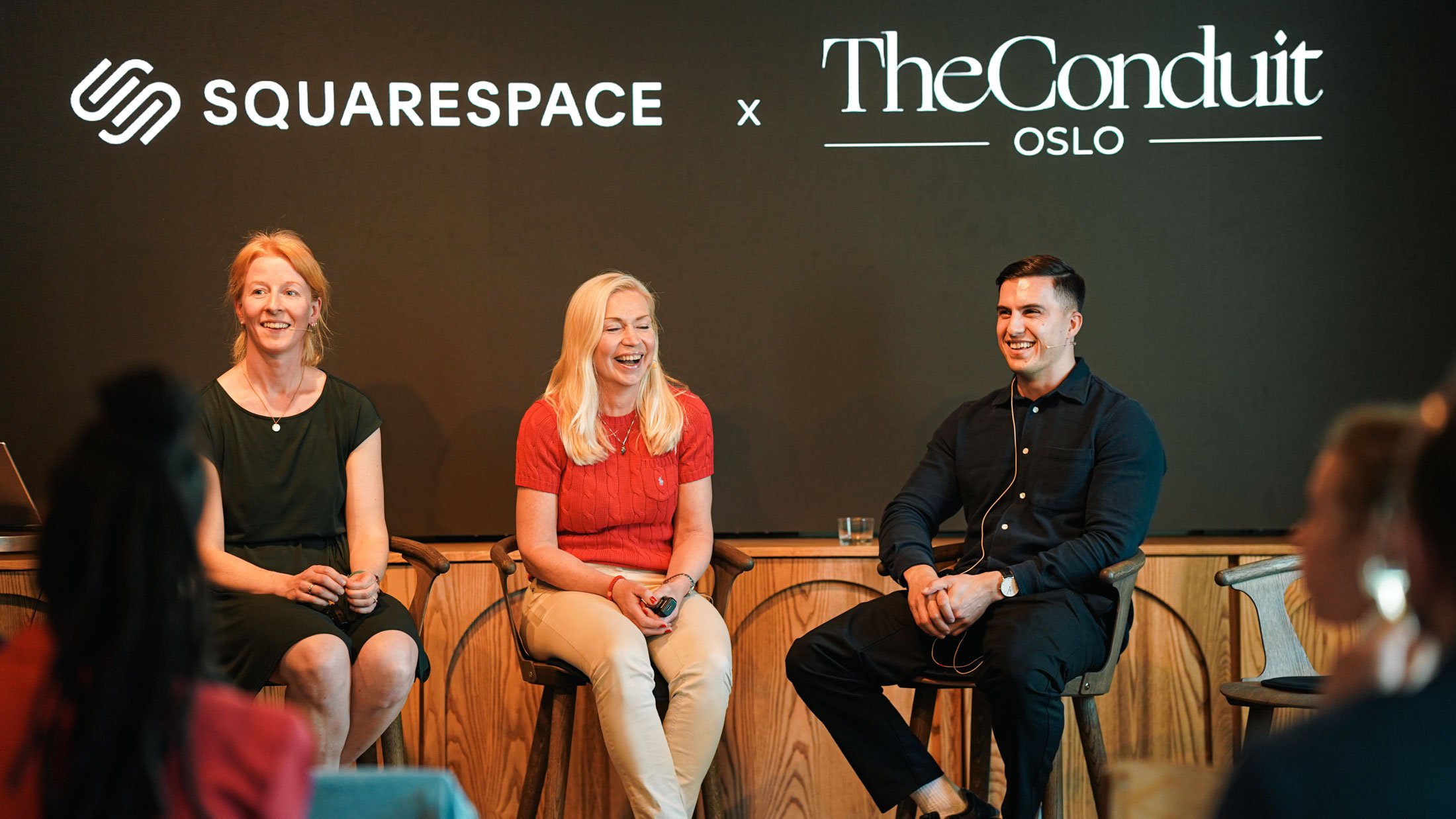
I was invited by Squarespace to take part in a panel discussion at The Conduit in Oslo, alongside Astri Knudsen (Gasta Design & Kommunikasjon) and Solveig Ellila Kristiansen (Hockeystick Impact).
The audience was made up primarily of founders, early-stage teams, and professionals navigating how their organisations show up digitally — not as a marketing exercise, but as part of how trust, credibility, and growth are built over time.
What followed was less a conversation about tools, and more a discussion about what digital presence actually is when stripped of trends and tactics.
Digital Presence Is Not Promotion
One idea that kept resurfacing during the discussion was this:
A digital presence is not something you “launch.”
It is something you maintain, clarify, and stand behind.
When I spoke about my work at Inclusive Creation, I described digital presence as infrastructure rather than output. Like a physical space, it signals intention before a single word is spoken. It tells people whether care has been taken, whether decisions were deliberate, and whether the organisation understands who it is for.
A website, in that sense, is not a campaign.
It is a home.
What Actually Carries Weight Online
Rather than listing channels or platforms, the panel conversation naturally gravitated toward what consistently holds up across industries.
Not novelty — but coherence.
Not reach — but recognisability.
Not activity — but clarity.
From my perspective, three elements tend to carry real weight:
A considered website, built to last longer than a trend cycle
Clear ownership and discoverability, often expressed through search and business profiles
Selective presence elsewhere, rather than scattered activity everywhere
This isn’t about doing more. It’s about doing fewer things well enough that they compound.

Where Things Commonly Break Down
When founders asked about mistakes, the answers were familiar — but the underlying issue was almost always the same.
Teams confuse visibility with meaning.
Websites become decorative instead of communicative.
SEO is treated as an afterthought.
Design decisions are made without considering how people actually move through information.
The result is not failure — it’s friction. Quiet friction that slowly erodes trust.
Avoiding this doesn’t require sophistication. It requires restraint, structure, and a willingness to say no to unnecessary complexity.
On AI and the Temptation to Accelerate
Artificial intelligence came up, as it inevitably does.
My position was cautious by design.
AI can accelerate production, analysis, and iteration. But acceleration only helps when direction is already clear. Without judgment, AI simply helps you get lost faster.
Used well, it supports decision-making.
Used poorly, it amplifies noise.
The question is not whether to adopt AI tools, but what kind of thinking they are allowed to support.

Measuring What Actually Matters
Toward the end of the panel, the conversation turned to measurement.
Metrics only matter when they reflect intent.
Awareness, inquiries, engagement, usage — all of these are valid indicators, depending on context. The mistake is treating them as universal rather than situational.
Good measurement doesn’t prove success.
It helps you decide what to do next.
A Closing Thought
Being part of this panel was valuable not because of scale or spectacle, but because it reinforced something I see repeatedly in my work:
Strong digital presence is rarely about growth in the abstract.
It is about alignment — between what an organisation says, what it builds, and how it behaves over time.
That alignment cannot be automated.
It has to be chosen.